The Opening Gap and Intraday Breakouts in Nasdaq-100 Futures: Day Selection, Replication and Data Quality
Ludwig J. Marx · 13 pages · JEL G13, G14, C12, C58 · CC BY-NC-ND 4.0
The direction of the opening gap adds little over a random one. The breakout after the open earns on wide trend days and loses on quiet ones. A rule that selects days by the opening minutes earns 16.8 % a year with real orders in Micro Nasdaq-100 futures from 2020 to 2026. It fails the registered hurdle, and in the test sample 2015 to 2019 it lost money.
- moderateThe overnight gap is a weak guide to direction. It beat a random direction in 4 of 24 rules, all of them weak ones; the first minutes of the session give a better direction.
- moderateBreakout rules after the open lose 27 basis points a day in the quietest fifth of days and earn 37 in the widest. The result depends on which days are traded.
- moderateResearch model and replication agree trade by trade (0.212 R on 620 common days) after three sources of difference were found.
- moderateThe selected rule does not hold out of sample: it beat 99.8 % of random-direction runs in 2020 to 2026 and 30 % in 2015 to 2019.
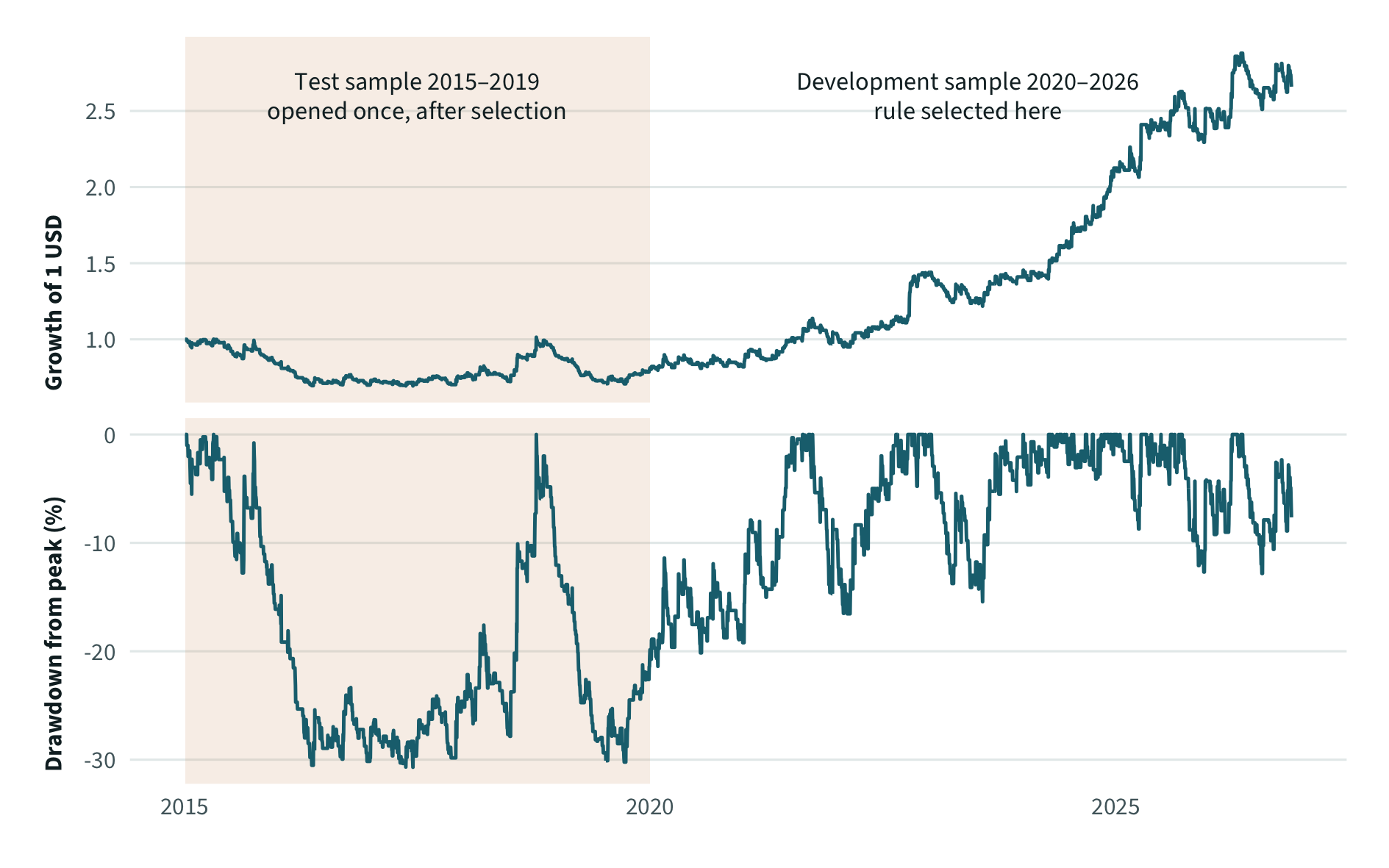
Out of sample 2015–2019
I test whether the opening gap of the Nasdaq-100 can be traded within the day: enter in the direction of the gap when price leaves the opening range, and hold to the close. The rules were developed in R on vendor data. Every reported result is recomputed on QuantConnect, with real orders in Micro Nasdaq-100 futures. The gap direction adds little, and the breakout earns only on wide days. A rule that selects days by the first minutes earns 16.8 % a year with real orders. It does not meet the registered hurdle and fails in the test sample 2015 to 2019 (Sharpe ratio −0.18).
Marx, L. J. (2026). The Opening Gap and Intraday Breakouts in Nasdaq-100 Futures: Day Selection, Replication and Data Quality. Working Paper 1. https://ludwigjmarx.com/research/wp1-opening-gap-breakouts